Beyond Tribalism: Evaluating Mamdani vs. Netanyahu
Political debates often begin with conclusions.
Good reasoning begins with questions.
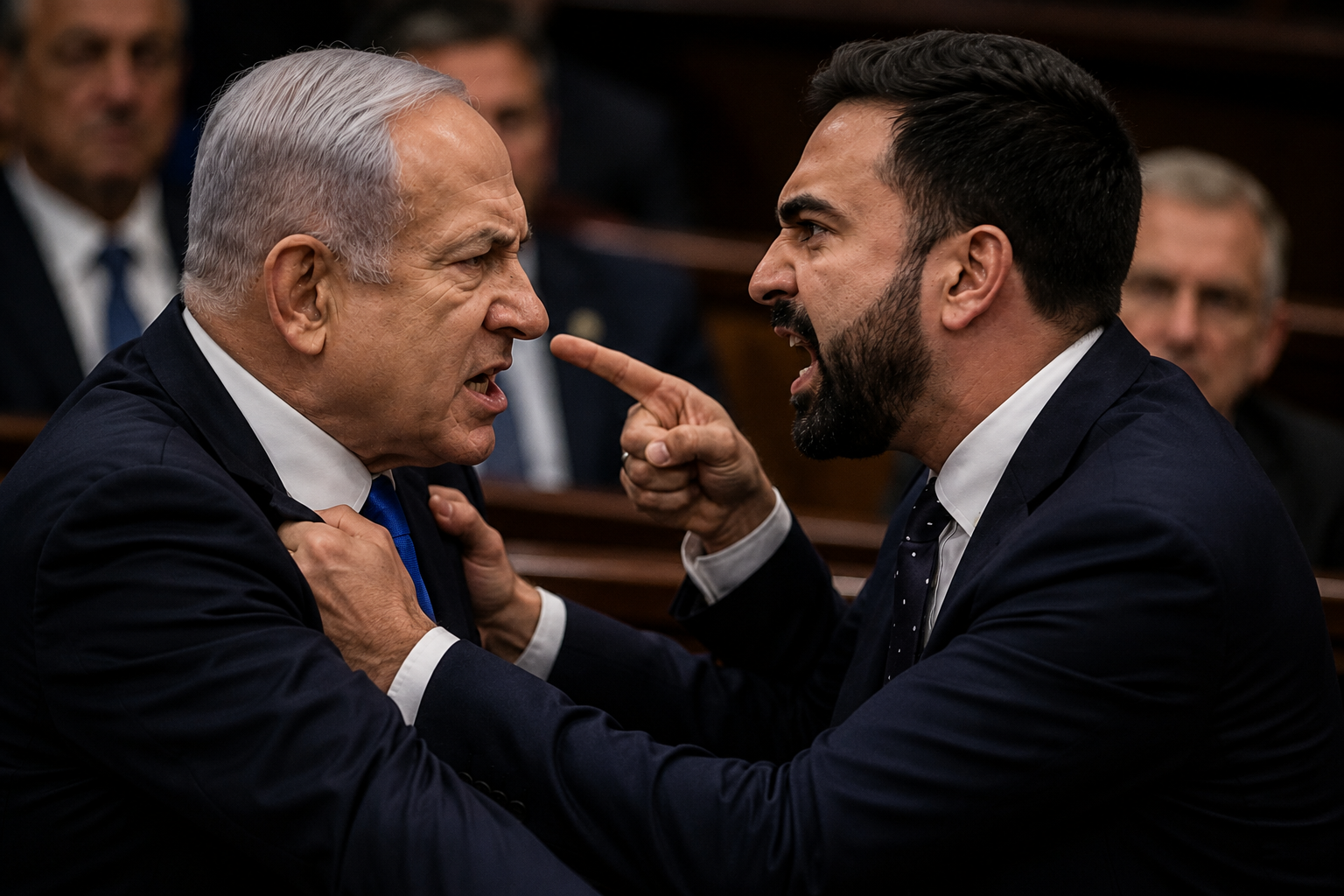
Recently, New York City mayoral candidate Zohran Mamdani referred to Israeli Prime Minister Benjamin Netanyahu as a war criminal. Netanyahu responded by attacking Mamdani’s character rather than directly addressing the accusation.
Whether you ultimately agree with Mamdani or Netanyahu, I believe we should resist the temptation to think tribally.
Instead, we should separate facts, assumptions, legal standards, and moral principles before reaching a conclusion.
Let’s examine the argument.
Mamdani’s Argument
During an interview with Lulu Garcia-Navarro, Mamdani said:
“He’s a war criminal who has been charged by the International Criminal Court.”
His argument is essentially this:
Netanyahu’s conduct during the Gaza war—including the scale of civilian casualties and the alleged restriction of humanitarian aid—has crossed the legal and moral threshold for war crimes.
That is a serious accusation.
The question is whether it survives careful scrutiny.
Netanyahu’s Response
Netanyahu replied during an interview with Sid Rosenberg:
“Who does he champion? Hamas… Those who hate the Jews and Israel ultimately hate America.”
Notice something important.
Netanyahu does not directly answer the accusation.
Instead, he argues that Mamdani sympathizes with Hamas and even hates America.
Even if those claims were true, they would not determine whether Netanyahu committed war crimes.
This is an example of an ad hominem response.
The legal question remains unanswered.
The Real Question
Rather than asking,
Is Netanyahu evil?
or
Is Mamdani antisemitic?
I think the better question is:
What makes someone a war criminal?
That question moves us beyond personalities and toward principles.
Was Israel’s Military Objective Legitimate?
On October 7, 2023, Hamas launched one of the deadliest terrorist attacks in Israeli history.
Approximately 1,200 people were killed, and around 250 hostages were taken into Gaza.
Israel responded with three stated objectives:
- Destroy Hamas’s military capabilities.
- Rescue the hostages.
- Prevent another attack.
Nearly every government, including many that later criticized Israel’s conduct, accepted that Israel had the right to respond militarily.
The debate, therefore, is generally not whether Israel could wage war.
It is how that war was conducted.
The Principle of Proportionality
International humanitarian law does not prohibit all civilian deaths.
If it did, modern warfare would often become impossible.
Instead, the law asks several questions:
- Was there a legitimate military objective?
- Was there a military target?
- Were reasonable precautions taken to protect civilians?
- Was the expected civilian harm excessive compared with the anticipated military advantage?
This is known as the principle of proportionality.
Notice something important.
International law does not compare deaths one-for-one.
It does not say:
“If one side loses 1,200 people, the other side may only lose 1,200 people.”
Instead, proportionality asks a more difficult question:
Did the anticipated military advantage justify the expected civilian harm?
Why Does Proportionality Exist?
This raises an even deeper philosophical question.
Why should there be limits on military necessity at all?
The principle of proportionality rests on several important ideas.
Human dignity
Every civilian possesses moral worth independent of the conflict.
A child, doctor, journalist, or uninvolved civilian does not lose that moral worth simply because they happen to live near military targets.
Their lives must still count in military decision-making.
The distinction between combatants and civilians
International humanitarian law draws an important distinction.
Combatants and military objectives may be attacked.
Civilians, as such, may not.
Because military forces sometimes operate within civilian populations, proportionality attempts to balance military necessity with humanitarian protection.
Necessity is not unlimited
Suppose destroying one enemy tank required destroying an apartment building filled with hundreds of civilians.
Would that military advantage justify that civilian cost?
The principle of proportionality answers:
Not every military objective justifies every civilian harm.
Just War Theory
Long before modern international law, philosophers such as Augustine and Thomas Aquinas argued that even a just war has moral limits.
The goal of war is not simply victory.
It is victory pursued within moral constraints.
The Difficult Question
This is where reasonable people begin to disagree.
Since the war began, Gaza health authorities have reported tens of thousands of Palestinian deaths. Israeli officials dispute aspects of those figures, particularly the distinction between civilians and combatants, while many international organizations consider the ministry’s overall death counts broadly credible despite limitations. Determining the precise civilian-to-combatant ratio remains difficult.
Does the sheer number of civilian deaths establish disproportionality?
Not necessarily.
International law does not ask whether casualties were equal.
It asks whether civilian harm became excessive relative to the anticipated military advantage.
That is a far more difficult judgment.
An Alternative View of Military Necessity
Israel’s conduct appears to reflect a different interpretation of military necessity.
One possible interpretation is this:
The greater the existential threat, the greater the permissible civilian cost.
The reasoning might be:
Hamas demonstrated both the willingness and ability to carry out mass civilian attacks.
If Israel does not decisively eliminate that threat, future attacks become more likely.
Under this view, military necessity expands because the stakes are existential.
Whether that interpretation is morally or legally correct is precisely what remains under debate.
A Thought Experiment
Imagine North Korea launched a devastating terrorist attack against South Korea.
Thousands of civilians were killed.
Hundreds were kidnapped.
North Korea embedded its military infrastructure within apartment buildings, schools, and hospitals while promising future attacks.
How much civilian harm would South Korea be justified in causing to eliminate that threat?
Most people would agree there must be some limit.
The difficult question is where that limit should be.
That is the proportionality question.
What About Starvation?
Another major accusation concerns humanitarian aid.
Critics argue that Israel deliberately restricted food, water, medicine, fuel, and humanitarian aid in order to pressure Hamas.
Israel disputes this characterization.
Israeli officials argue that restrictions were intended to prevent supplies from reaching Hamas, that Hamas diverted aid, and that distributing aid safely during an active war posed significant challenges.
The legal issue is not simply whether civilians suffered starvation.
It is whether starvation was intentionally used as a method of warfare against civilians.
That factual dispute remains central to the legal analysis.
Moving Beyond Tribalism
Political tribalism encourages us to begin with a conclusion.
Reasoning asks us to begin with questions.
So before deciding whether Netanyahu is a war criminal, I think we should ask ourselves:
- Should military necessity have moral limits?
- If so, how should those limits be determined?
- How much civilian harm can ever be justified in eliminating an existential threat?
- Does the use of human shields change our moral evaluation?
- At what point does civilian suffering become legally and morally excessive?
How we answer those questions will largely determine whether we conclude that Israel’s campaign remained within the principle of proportionality—or crossed the line into a war crime.
The goal of political reasoning is not to begin with certainty.